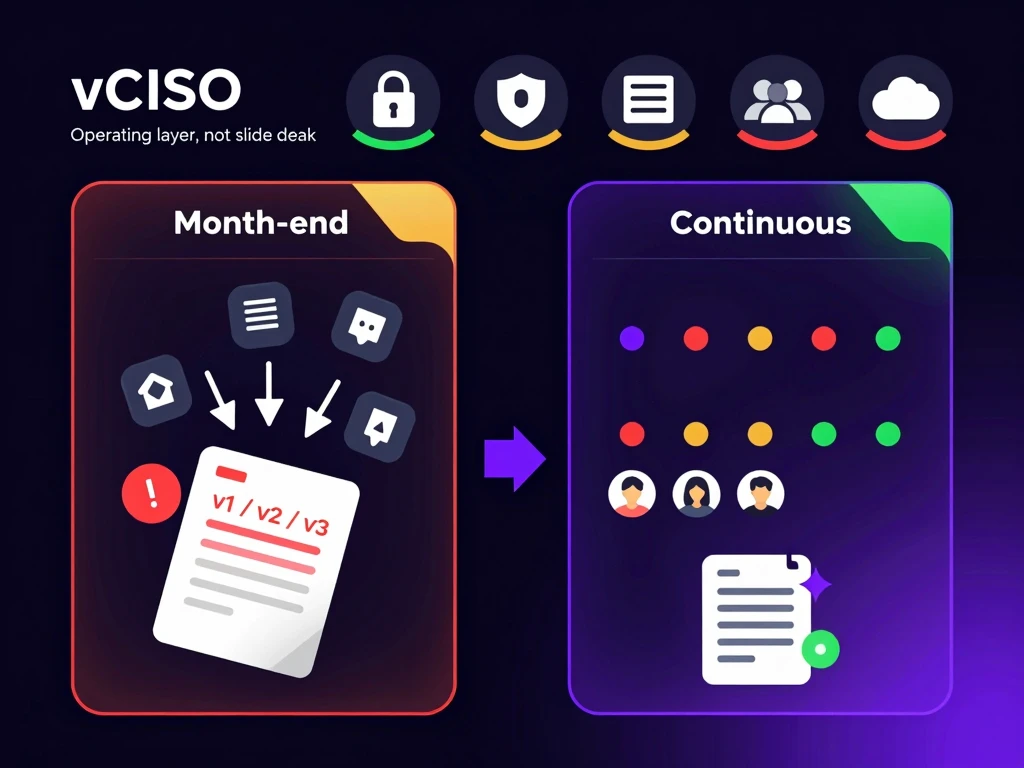
Most companies do not have a reporting problem. They have a coordination problem.
The board asks for a clean monthly update. The CEO wants a credible answer on risk. The CTO wants to know whether the program is actually improving. Meanwhile, the person doing the work, usually an IT leader, security lead, or fractional CISO, is stuck chasing screenshots, exporting CSVs, nudging people for status, and translating operational mess into executive language.
That is the real enemy here: manual spreadsheet hell disguised as governance.
One vCISO told us in an expert interview, “If I spend the first half of every client call reconstructing what happened, I am not acting like a strategist. I am acting like a reporting clerk with security certifications.”
That line lands because it is true. Companies hire a vCISO for judgment, prioritization, and early warning. They do not hire one to fight version control problems in PowerPoint and Excel.
Why manual reporting breaks down so fast
The breaking point usually arrives quietly. A company adds more SaaS tools. The team grows. Offboarding gets a little messier. Evidence for audits lives in three different places. The vCISO now supports several clients or one client with several internal stakeholders, and each monthly review starts to feel like archaeology.
By then, the damage is already operational:
- leadership sees polished slides but not the uncertainty underneath them
- IT becomes the nagging function that keeps asking for updates
- security discussions drift toward anecdotes instead of trends
- too much tribal knowledge stays trapped in one person’s memory
This is not just inefficient. It is risky.
Manual reporting makes that worse because it rewards last-minute assembly over continuous visibility.
What a vCISO portal is actually supposed to do
In plain English, a vCISO portal is the working surface where security operations, executive reporting, and follow-through meet. It should not be another dashboard that looks impressive during a sales demo and gets ignored the rest of the month.
It should behave more like an orchestra conductor’s score. Not the music itself, but the shared structure that lets everyone stay in tempo without relying on memory.
That matters because a good advisor does not need more tabs. They need context:
- what changed since the last review
- which risks are moving toward the crown jewels
- where ownership is unclear
- which actions are overdue
- what leadership needs to decide now
When that context is visible, reporting becomes a review exercise instead of a writing exercise.
The shared enemy: the SSO tax, tool sprawl, and manual status-chasing
Most IT operators already know this pain. The company buys another SaaS product. Proper SSO or SCIM support sits behind a more expensive plan. Offboarding stays partially manual. Access reviews happen by spreadsheet because the system of record is fragmented.
SSO, or single sign-on, means users authenticate once through a central identity provider instead of managing separate credentials everywhere. SCIM is the provisioning standard that automatically creates, updates, and removes user accounts across tools. In plain English, SCIM is what stops onboarding and offboarding from depending on somebody remembering to click through six admin consoles on a Friday night.
When those controls are missing, the reporting burden does not disappear. It moves onto humans.
That is where relationships start to fray. IT has to chase HR for departures, managers for approvals, finance for license context, and app owners for screenshots. Security begins to feel like a traffic cop. People get defensive. Everyone says they support security “in principle,” but nobody wants another workflow.
A good security operating model has to respect that reality. IT is not there to block work. Its best form is almost invisible: the connector that helps people get the right access quickly, safely, and with less drama.
A realistic scenario
Imagine a 180-person SaaS company. The IT manager is competent but stretched. Engineering owns part of the cloud estate. HR owns joiners and leavers in theory, but not every workflow is clean in practice. The vCISO is there a few days each month. Enterprise prospects are asking harder security questions. The board wants confidence.
Now imagine a developer leaves on a Friday evening.
In the old model, Monday starts with detective work. Was the laptop collected? Were GitHub, AWS, Jira, and the design tools cleaned up? Did a manager approve access exceptions months ago that nobody revisited? Did anyone remember the niche vendor platform that does not support SCIM unless you buy the enterprise tier?
By the time that story is assembled, half the review cycle is gone.
In a portal model, the month has already been structured while work happened. The access review status is visible. Ownership gaps are obvious. Overdue actions are already ranked. The vCISO comes into the meeting with a draft narrative and spends time on decisions:
- which identity gaps now create real business exposure
- where the company is scaling faster than its controls
- what needs executive escalation instead of another reminder email
That is the difference between clerical security and operational security.
What changes when reporting stops being manual
The first benefit is time, but time is not the most important outcome.
The real gain is trust.
When operating data is visible throughout the month, the vCISO is no longer asking teams to recreate reality on demand. The conversation changes. Instead of “Can you send me the latest spreadsheet?” it becomes “Here is where risk is stalling, and here is the trade-off if we delay.”
That is better for leadership because they get cleaner decisions. It is better for IT because they stop carrying the emotional load of being the department that always nags. It is better for the vCISO because their role shifts back to what it should be: interpreter, lifeguard, and escalation point.
There are trade-offs, and they should be stated plainly. Building this operating layer takes discipline. Some integrations will still be expensive. Some tools will still sit behind vendor lock-in or the SSO tax. Some internal teams will resist yet another process change. Security is a journey, not a destination, and a portal does not remove the politics from that journey.
But it does remove a large amount of avoidable friction.
Pragmatic roadmap
If you want to get out of manual reporting without buying another shelfware dashboard, start here:
- Define the five to seven security domains leadership actually cares about, such as access governance, endpoint hygiene, vendor risk, and incident readiness.
- For each domain, write a plain-language definition of what “good enough this quarter” means.
- Standardize one source of truth for actions, owners, due dates, and status changes.
- Capture the same operating snapshot on a fixed cadence instead of rewriting the story from memory each month.
- Draft the board update from live operating data first, then let the vCISO edit for judgment and context.
- Review flat or worsening areas before polished wins. That is where situational awareness usually lives.
Quick checklist for IT and vCISO teams
- Are we still rebuilding the same narrative every month from scratch?
- Can leadership see what changed since the last review without asking for a custom deck?
- Do we know which overdue actions threaten the crown jewels versus which ones are mostly noise?
- Are offboarding, access reviews, and exception handling visible in one place?
- If our vCISO disappeared for two weeks, would the operating context remain intact?
If too many of those answers are no, the problem is not the quality of your slides. It is the quality of your operating model.
From reporting to operational GRC
This is the larger shift. Traditional GRC often turns security into a bureaucratic artifact: controls on paper, status in spreadsheets, confidence by presentation. Operational GRC is different. It ties governance to the work people are actually doing, the decisions leaders actually need to make, and the friction operators are actually feeling.
That is the philosophy behind AutoCISO’s vCISO Portal. Not prettier reporting for its own sake, and not another place to admire charts. The point is to turn scattered security work into a usable decision surface so the monthly report becomes a by-product of running the program well.
That is when a portal stops being a dashboard and starts being an operating layer.