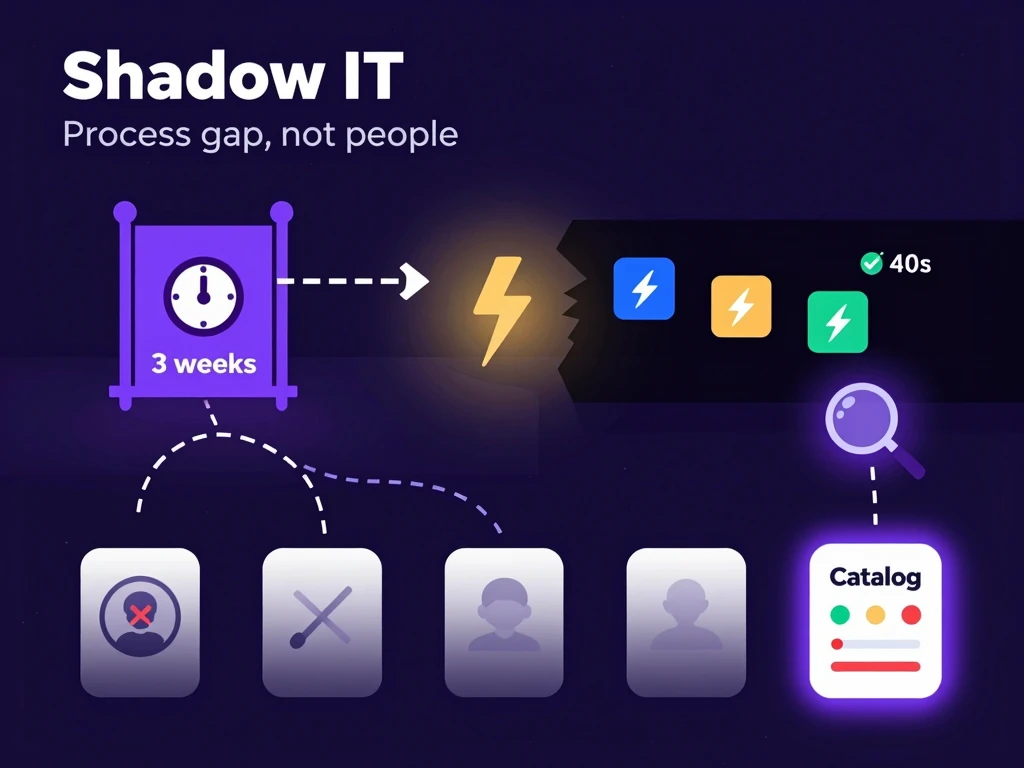
The employee who signed up for a new AI writing tool using their work email isn’t trying to circumvent your security team. They have a deadline, their approved tool doesn’t do what they need, and the new tool requires nothing more than a Google login.
They did not consult IT. They did not wait for a vendor review. They were done in forty seconds.
From a security perspective, that’s a problem. From their perspective, it was Tuesday.
The Framing That Makes Shadow IT Worse
Most shadow IT programs are built on a fundamentally adversarial assumption: employees are the risk vector, and the solution is better enforcement. Stricter policies. Tighter controls on expense reimbursement. Automated scanning that catches them.
This framing is not wrong — it does catch unauthorized tools. But it misses the underlying dynamic, and that makes it expensive to sustain.
When employees adopt tools outside the sanctioned process, they are almost always solving a real problem that the sanctioned process failed to address. The design team needed a prototyping tool faster than procurement could move. The sales team needed a CRM feature their approved vendor didn’t offer. The data analyst needed a notebook environment that the company’s standard tooling didn’t support.
Security culture doesn’t improve when employees feel like the security team is a wall they have to work around. It improves when they see security as something that exists to help them work safely and effectively.
What Shadow IT Actually Costs
The financial case against shadow IT is real but usually understated — and in the wrong direction.
The obvious cost is overspend: duplicate licenses, tools that overlap with approved products, subscriptions nobody tracks because they were expensed rather than procured. Organizations routinely find that 30 to 40 percent of their SaaS environment is redundant or unmanaged. For a 100-person company spending $3,000 per employee per year on SaaS, that’s a six-figure problem.
The less visible cost is security exposure. An unsanctioned tool that processes customer data — even unintentionally — is a compliance event waiting to happen. SOC2, GDPR, HIPAA, and ISO 27001 all require that you can account for where sensitive data flows. If you don’t know the tool exists, you can’t assess it, configure it properly, or include it in your access review process.
The least visible cost is the access residue that accumulates over time. Every tool adopted outside IT’s view is a set of credentials that IT doesn’t manage, can’t revoke centrally, and won’t catch when the employee leaves. Multiply that by a company that’s been growing fast for three years and you have dozens of orphaned accounts with valid credentials sitting in apps your security team has never audited.
What Works — and Why Restrictive Policies Usually Don’t
Pure enforcement rarely reduces shadow IT adoption. It tends to push it further underground instead.
When a company eliminates the ability to expense unauthorized SaaS — as some do — it often reduces the visible shadow IT footprint while the actual footprint stays largely the same. Employees find workarounds: personal credit cards, third-party contractors who bring their own tools, browser extensions that don’t show up in spend analysis.
What actually moves the needle is reducing the friction that creates shadow IT in the first place.
Fast-lane procurement for low-risk tools. If the approval process for a $15/month SaaS subscription takes three weeks, people will skip it. A lightweight review track for low-cost, low-data-risk tools — reviewed in days, not months — removes the incentive to go around the process.
An approved alternatives catalog. When employees know there’s a vetted option that does what they need, adoption of the unsanctioned option drops sharply. Maintaining a searchable catalog of approved tools by category is cheap to build and effective at shaping default choices.
Discovery before enforcement. You can’t manage what you haven’t found. OAuth scanning, expense data analysis, and DNS traffic monitoring give you a realistic picture of what’s actually in use before you decide what to do about it. Enforcing restrictions against a shadow IT environment you can’t fully see tends to create conflict without improving the underlying posture.
Non-punitive discovery. Amnesty-style programs — “tell us what you’re using and we’ll help you get it approved or find an alternative” — surface far more of the real environment than audit-driven discovery. Employees who fear punishment hide tools. Employees who expect help report them.
The Goal Is a Smaller Attack Surface, Not Zero Tolerance
The realistic goal of a shadow IT program is not an environment where nothing happens outside IT’s approval. That environment doesn’t exist in any organization with more than ten people and a product deadline.
The goal is an environment where:
- The most sensitive data flows through managed, reviewed systems
- Access credentials are discoverable and revocable when employees leave
- The actual attack surface is known well enough to be defended
- Employees view the security team as a partner rather than a blocker
That shift in posture — from “how do we catch them” to “how do we make the secure path easier than the insecure one” — is what distinguishes security programs that actually reduce risk from ones that mostly generate audit findings.
Your employees are not the problem. The gap between what they need and what IT has made available is the problem. Shadow IT is just where that gap shows up.