Managing security across five client organizations sounds like a compelling business model — until Monday morning arrives and you are staring at five different Notion boards, three shared spreadsheets, and a queue of unread emails from clients asking why their board pack isn’t ready yet.
Fractional CISO work has real leverage. You carry expertise earned across dozens of engagements. You see patterns that an in-house team, buried in a single organization, never will. But that leverage evaporates the moment the operational overhead of managing five clients approaches the cost of managing five clients. This is the trap most vCISOs fall into somewhere between client two and client four.
The problem is tool sprawl, not workload
The instinct is to blame volume. “I have too many clients.” But the actual bottleneck is almost never headcount — it’s the absence of a shared operational layer.
Most fractional CISOs run their practice on a combination of tools that were never designed to work together. A Notion workspace per client for documentation. A spreadsheet tracking open remediation items. Email threads for report delivery. A calendar blocked for writing time every month. The result is a coordination tax that compounds with every new client you add.
Every context switch has a cost. When you move from client A to client B, you don’t just change the name at the top of a document — you re-load the entire mental model of that organization’s posture, open issues, and stakeholder relationships. Without a consistent structure across clients, that re-load takes 15–20 minutes per session. Multiply that by five clients, twice a week, and you’ve lost more than three hours to cognitive overhead before you’ve done a single productive thing.
Report grind is the hidden tax. The monthly board pack is where the model really breaks. A well-structured executive summary, risk narrative, and remediation priority list for a single client takes two to three hours to write from scratch. For five clients, that’s an entire working week every month — before accounting for client calls, access reviews, or incident response.
No shared signal means no portfolio perspective. When each client’s security posture lives in a silo, you cannot answer the most valuable question a vCISO can ask: what patterns am I seeing across my portfolio this week? Spotting a configuration drift that appeared in three client environments before it became an incident is exactly the kind of value a fractional CISO should be delivering. You cannot deliver it from five separate spreadsheets.
The solution: a consistent weekly operating system
The practices that work at scale share a common structure: a fixed weekly rhythm, a single place where all clients surface simultaneously, and a repeatable report format that can be reviewed and approved rather than written from scratch.
Start with a portfolio view, not a client view. Your Monday review should begin by scanning all clients at once — sorted by what needs attention, not alphabetically. Which clients had new findings since your last session? Which access reviews are overdue? Where did the risk score move since last week? A portfolio board that surfaces this across all clients turns your Monday check-in from a context-switching marathon into a 15-minute triage.
Build your weekly action queue before you open any client’s workspace. List the three to five actions across all clients that will have the highest impact this week. Critical findings first. Overdue items second. Proactive improvements third. This queue-first approach prevents the trap of spending all your client time in the one loudest organization while the quiet ones accumulate technical debt.
Treat the board pack as a review task, not a writing task. The most efficient vCISOs I’ve spoken with describe their monthly reporting as “filling in what the draft got wrong,” not writing from a blank document. When your tooling can generate a structured draft — executive summary, risk narrative, top three remediation priorities — your job becomes editorial, not authorial. That shift alone recovers the equivalent of a full working week per month for a five-client practice.
Deliver consistently, not manually. A board pack that arrives by email from your personal account at 11pm the night before a board meeting signals that you are working hard but not at scale. Systematic delivery — same format, same timing, sent from a consistent platform — signals that your practice is a professional operation, not a one-person consultancy held together with productivity apps.
Practical structure for the weekly vCISO session
A sustainable weekly rhythm for a five-client practice looks like this:
- Portfolio triage (15 min): Review all clients sorted by priority score. Flag anything that needs same-week action.
- Action queue (30 min): Work through the week’s ranked cross-client actions. One focused session beats five fragmented ones.
- Deep dives (variable): For the one or two clients that need detailed attention that week, enter their workspace with full context already loaded.
- Monthly board pack review (when due): Read the AI draft for each client, adjust the narrative, approve, and send.
That structure, consistently applied, is what lets a fractional CISO manage a ten-client portfolio without adding hours to the week. The difference is not effort — it’s architecture.
What changes when you have the right tooling
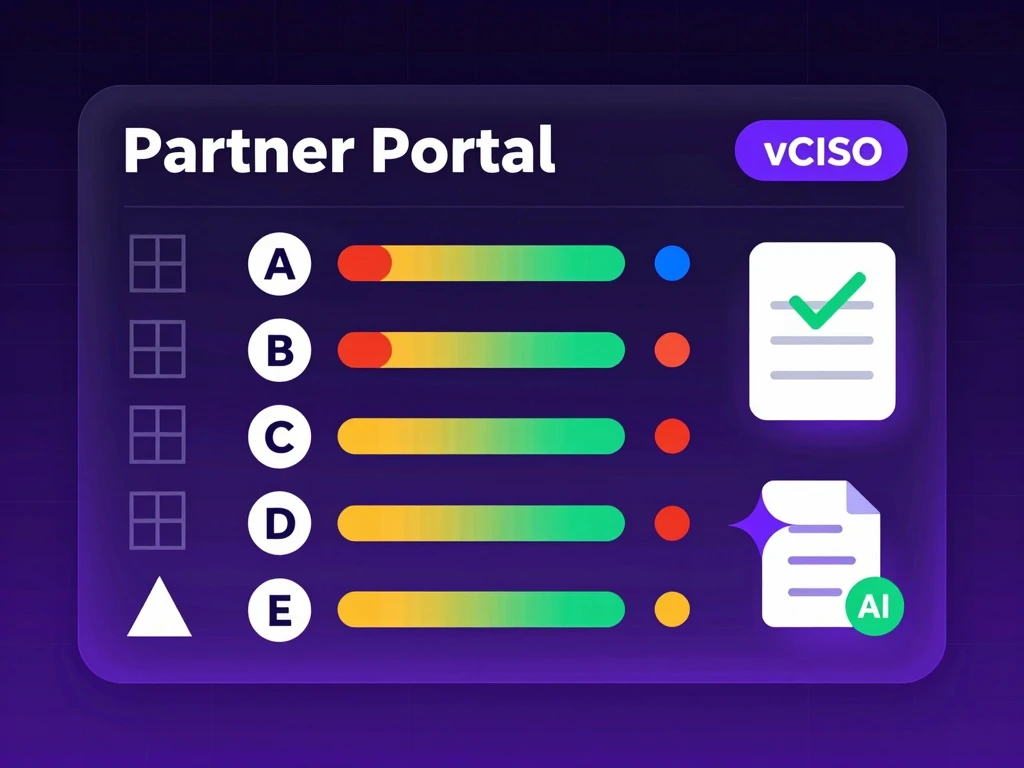
AutoCISO’s Partner Portal was built around this operating model. The portfolio board surfaces all managed clients sorted by their current risk priority, so your Monday triage is a scan, not a search. The weekly action queue ranks open findings cross-portfolio, so you triage in one place rather than opening five tabs. The AI Board Pack Generator drafts the executive summary and risk narrative based on what actually changed in each org during the period — you read, adjust, and approve rather than writing from scratch. And delivery happens from the portal directly to your client contacts.
The goal is to make the ten-client practice feel like the five-client practice — and to make the five-client practice feel like one client, managed well.
If you’re running a fractional CISO practice and still doing this from spreadsheets, the overhead isn’t a sign that you’ve hit your limit. It’s a sign that you’re missing the layer that makes scale possible.